
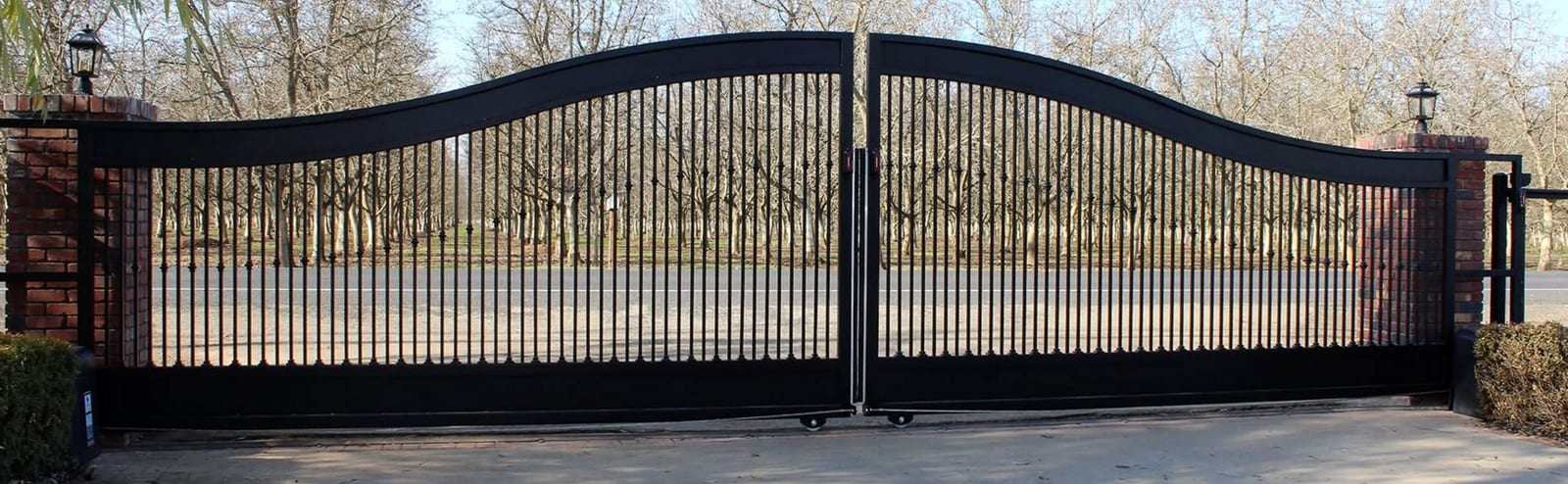
Gate Installation in Columbus
We install new driveway, pedestrian and commercial gates, manual or automatic. We build and hang swing gates in wrought iron, aluminum and wood, and put in new automatic gates from the footings up to the operator and its controls.
Most of a gate’s working life is decided before the first post hole: the type, the material, the depth of the posts and where the power runs.
Choosing the Gate Material
A Columbus winter works on a gate two ways: freeze-thaw cycles push water into every joint, and road salt from the street settles on bottom rails and hinges.
| Material | Look | Strength | Upkeep | Freeze-thaw and road salt |
|---|---|---|---|---|
| Steel | Modern lines: flat bar, slotted panels | Very strong for its size, hard to dent | Touch up chips before rust creeps under | Lasts when galvanized and powder-coated |
| Aluminum | Ornamental pickets that read like iron | Light; bends on impact, so long leaves need bracing | Low: powder coat and an occasional wash | Doesn’t rust, so it suits gates near salted streets |
| Wrought iron | Forged scrolls, finials, the classic heavy look | Very strong and very heavy; needs stout posts | The most: paint whenever the coating wears | Rusts where paint fails, at the base and joints first |
| Wood | Warm, solid privacy to match a wood fence | Heavy and prone to twist without a brace | Stain or sealer every few years | Swells and shrinks with the cycles; rots at ground contact |
| Vinyl | Smooth white or tan privacy panels | Light and flexible; wide leaves need a metal insert | Washing, little else | No rust or rot, but brittle in hard cold and can crack |
Much of what’s called wrought iron today is forged-style steel, and it needs the same care with paint.

Swing, Sliding or Cantilever

The site usually picks the gate type before taste does. Measure the room behind the opening, the run along the fence beside it and how much the drive rises.
Swing gates suit most home driveways; sliding gates fit where there’s no room to swing. Cantilever gates need extra steel for their counterbalance tail, but they never touch the drive, so snow and gravel don’t stop them.
| Gate type | Space needed | Slope tolerance | Snow clearance | Typical use |
|---|---|---|---|---|
| Swing | A clear arc inside the opening, each leaf’s width deep | Low: a rising drive needs lift hinges | Snow in the arc stops the leaves until shoveled | Home driveways, ornamental entrances, pedestrian gates |
| Sliding | A run along the fence about as long as the gate | Needs a level track across the opening | The track packs with ice and must be kept clear | Driveways with no room to swing, business lots |
| Cantilever | A run about one and a half times the opening | Copes with an uneven drive, because nothing touches it | Rides above the ground with no track to clear | Industrial yards, wide openings, busy entrances |
Decisions to Make Before Installation
- Width. Measure the clear opening and think about what passes through: cars, a truck, a trailer. Every extra foot adds weight.
- Slope. Check the rise across the opening and through the swing area; a few inches can change the hinges or the gate type.
- Post footings below the frost line. Posts set above it get lifted by frozen clay, and the gate follows them out of line.
- Power source. An operator needs a circuit at the gate in trenched conduit, or solar with a battery where that isn’t practical.
- HOA approval. Many associations review style, height and color first. Get the answer in writing.
- Permit check. Ask the City of Columbus or your township or suburb about height limits, setbacks and any electrical permit for an operator.
Send photos of the opening and a few measurements with your request, and most of these are settled before anyone digs; it’s part of how we work.

Questions Before You Dig
Do I need a permit for a new driveway gate?
It depends on where the gate goes. The City of Columbus, the suburbs and the townships each set their own rules on height, setbacks from the sidewalk and street, and sight lines at corners. An automatic gate may also need an electrical permit for the operator’s circuit. Check with the building or zoning department before anything is dug.
Does my HOA have to approve a new gate?
If your HOA has architectural rules, assume so. Associations usually review style, height, color and placement, and some don’t allow driveway gates at all. Submit a drawing or a photo of a similar gate with the measurements, and wait for written approval. A city permit doesn’t replace HOA approval, and HOA approval doesn’t replace a permit.
How deep do gate post footings go in Ohio clay?
Below the local frost line, which the building department sets. In central Ohio that’s typically 32 inches, and gate posts often go deeper, because a hanging leaf levers on them. Clay holds water, and water freezing under a shallow footing lifts it. A wider base, gravel for drainage and a crowned top that sheds water help a post stay plumb.
Do I need to call Ohio 811 before a gate goes in?
Yes. Post holes are digging, and Ohio 811 needs at least 48 hours’ notice, not counting weekends and legal holidays. Whoever does the digging places the request, and the utilities mark their lines with paint or flags. Private lines aren’t marked, so point out any buried lighting, sprinkler or garage feeds yourself.
What Changes the Scope of an Installation
Two gates of the same width can be very different jobs.
| Factor | How it changes the job |
|---|---|
| Width | Wider leaves weigh more, so posts, hinges and footings grow; a very wide opening may suit a double gate or a cantilever. |
| Material | Iron and wood weigh far more than aluminum, which sizes the posts, the hinges and any operator. |
| Automation | Adds the operator, a power run, and the photo eyes and edge sensors UL 325 calls for; the gate itself should meet ASTM F2200. |
| Grade | A sloped drive can mean lift hinges, a leaf cut to the grade, regrading, or a cantilever instead of a swing gate. |
| Access control | A keypad or intercom post, a card reader and a buried low-voltage run to the operator join the job. |