
Gate Openers in Columbus
We supply, install, replace and upgrade automatic gate operators for swing, slide and barrier gates, whether the gate has always opened by hand or its operator is worn out. A whole new automated gate falls under gate installation.
A driveway gate in Dublin or Grandview Heights may cycle a few times a day. An HOA entrance or an apartment community’s gate may cycle hundreds of times, and it still has to work every morning. The operator has to match the traffic.
Size an Operator for Your Gate
Pick the gate, its size, its users and its power to see the UL 325 usage class, duty level and operator style that usually fit.
Choose the gate type, size, use and power, then press Show the Operator Class.
Operator Types Side by Side
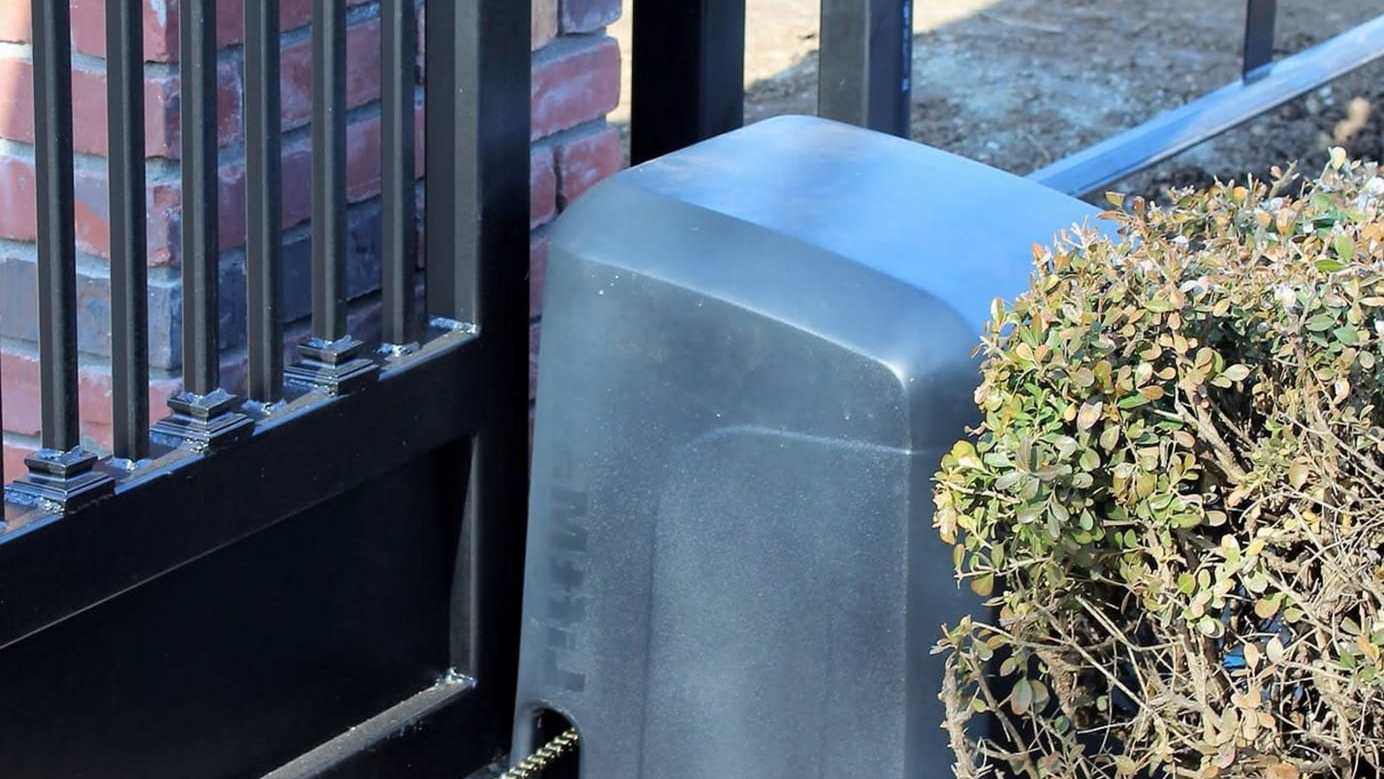
The gate decides most of this: swing gates take an arm or an underground operator, slide and cantilever gates a slide operator.
| Operator | Suits | Space needed | Notes |
|---|---|---|---|
| Swing arm | Single and double swing gates: linear arms on plain posts, articulated arms on wide piers | Room inside the hinge post for the arm and bracket, plus the leaf’s full swing | Easy to service. Leaves that open uphill or toward a wall need planning. |
| Underground | Swing gates where nothing should show, with leaves of modest length and weight | A steel foundation box under each hinge, set into the drive | The cleanest look, but in Ohio clay the box needs a drain line or the motor sits in water. |
| Slide | Slide and cantilever gates, from home drives to long commercial gates | A pad by the opening and clear fence line for the gate to roll back along | Gear rack or chain drive. Handles heavy gates and wind well; a ground track needs clearing in winter. |
| Overhead (vertical lift) | Industrial and secure sites with no room to swing or slide | Clear headroom over the opening and a steel tower at each side | Heavy structural work, chosen when the footprint is tight; rare outside industrial sites. |


Entrapment Protection and UL 325
UL 325 sets the safety rules for gate operators, and ASTM F2200 for the gates they drive. Every automated gate needs:
- Entrapment protection. Two independent means of protection at every spot where the gate could pin someone: the operator’s own sensing plus an external device.
- Photo eyes. Infrared beams across the opening, and across the swing path where a leaf opens toward a wall. Break the beam and the gate stops or reverses.
- Reversing edges. Pressure-sensitive strips on the gate’s leading edge and on posts where it could pinch. Touch one and the gate reverses.
- Manual release. A locked release that lets the owner free the gate by hand when the power or the operator fails.
- A UL 325 listed operator. Its label gives its usage class. A Class I home unit has no place on an apartment gate.
- Controls, signs and a walk gate. Push buttons six feet or more from the gate and in sight of it, warning signs on both sides, and a separate path for people.
Before we leave a new or replaced operator, we test that it reverses when it meets an obstruction and that the photo eyes stop the gate.
New Operators and Add-Ons
A replacement is sized from the gate, not copied from the old unit. Weight, traffic and UL 325 class decide the new operator, so a busier entrance may need a heavier model. A sound pad, conduit and wiring can usually stay.
An add-on suits an operator that still runs well: a rolling-code receiver, a phone module, battery backup, or monitored photo eyes and edges. A gate that sags or drags needs gate repair first: an operator is only as good as the gate it drives.
Questions About Openers and Remotes
How do I add or program another remote for my gate?
Most receivers learn a remote in under a minute: press the learn button on the receiver or control board, then the remote’s button. The remote must match the receiver’s frequency and code type, so check before buying.
Rolling-code remotes change their signal with every press, so a recorded signal won’t open the gate; a new receiver brings that to an older fixed-code operator. Lost a remote? Clear the receiver’s memory and relearn the ones you still have.
Can I open my gate from my phone?
Yes, with a Wi-Fi or cellular module connected to the operator. Wi-Fi needs a strong signal at the gate, which often sits beyond the house router’s reach; an outdoor access point fixes that. Cellular modules work where Wi-Fi won’t, on a data plan.
Either one works only with a control board or receiver that accepts it, so check compatibility first. Phone control adds to the remotes rather than replacing them.
Can an operator be fitted to the gate I already have?
Often, yes. The gate must be stiff enough to be pushed from one point without flexing, hang level on sound hinges or rollers, and move freely by hand without drifting. Its weight sets the operator size, and there has to be clearance for the arm or the slide travel.
The old latch comes off or gets disabled, because a latch fighting an operator is a hazard. Send photos and measurements of the hinge side first, and the visit starts with the right parts.
Battery Backup and Solar Options
Spring and summer storms knock out power around Columbus, and ice storms do it in winter. Battery backup keeps a gate in service through them. It needs a DC operator, or a backup unit made for the AC model, and a battery sized for the gate’s weight and the cycles you’d need during an outage. Batteries lose capacity in the cold and wear out in a few years, so test yours every fall.
Solar suits a gate far from a power line, on light use. The panel charges the same battery, so it needs direct sun, a south-facing mount and no tree shade, sized for December’s short, gray days. A busy gate needs AC power. A gate already stuck in an outage is covered under stuck gates.